slideshow

A slideshow of images from Lorem Picsum
Showing posts with label TechCrunch. Show all posts

Tuesday, October 23, 2018

TECH NEWS:~ Local venture capital fund formation is on the rise in Africa, led by Nigeria

Africa’s VC landscape is becoming more African with an increasing number of investment funds headquartered on the continent and run by locals, according to data from Crunchbase.

The study also tracked the emergence of homegrown corporate venture arms and more Africans in top positions at outside funds. These results derived from a year-long project to boost Crunchbase’s Africa data capture and increase awareness of its platform across the continent’s tech ecosystem.

Drawing on its database and primary source research, Crunchbase identified 51 “viable” Africa-focused VC funds globally—defining viable as formally established entities with 7-10 investments or more in African startups, from seed to series stage.

Those who made the list with 7 investments indicated they would reach 10 by early 2019.  

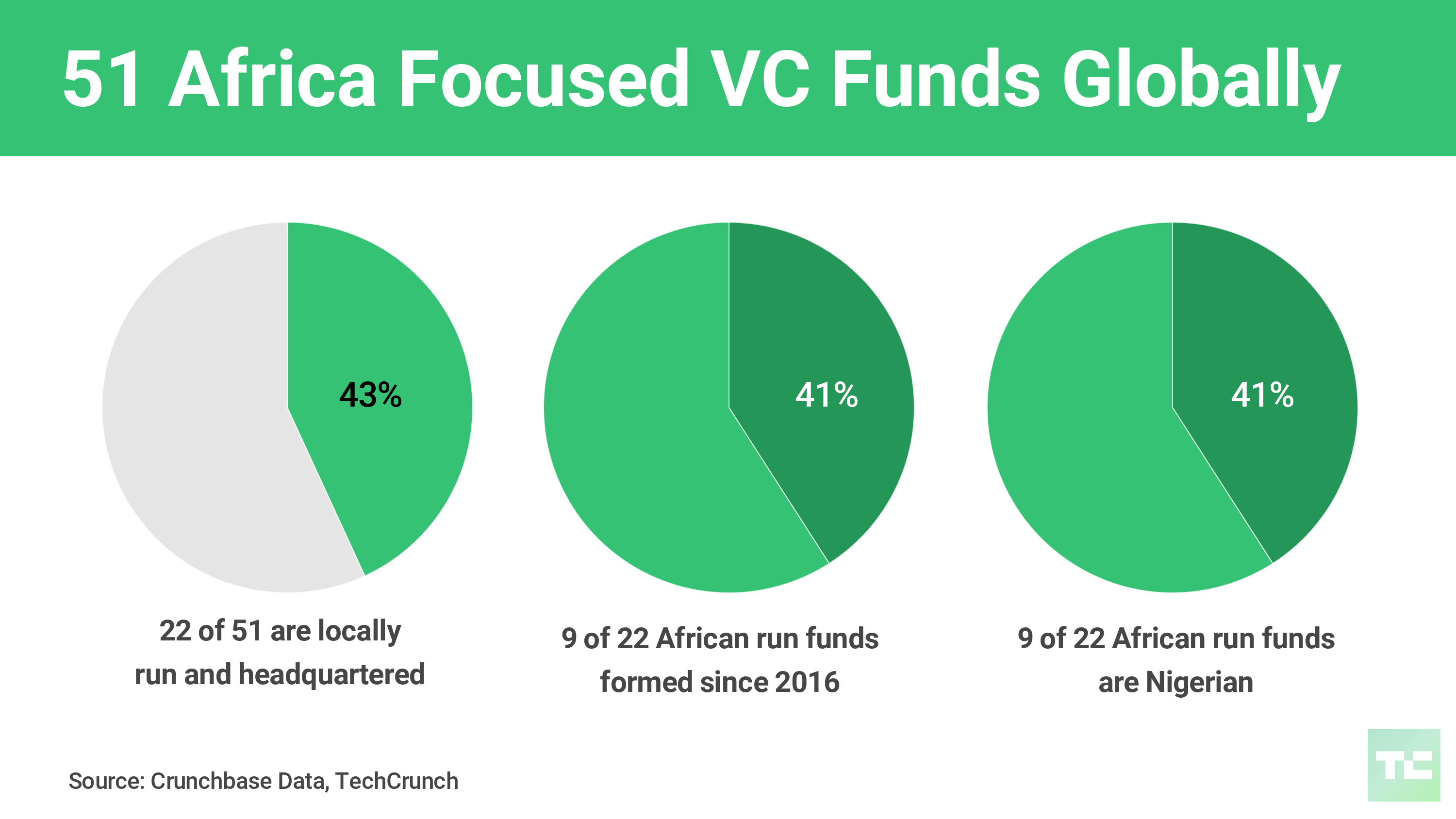
Of the 51 funds investing in African startups, 22 (or 43 percent) were headquartered in Africa and managed by Africans.

Of the 22 African managed and located funds, 9 (or 41 percent) were formed since 2016 and 9 are Nigerian.

Four of the 9 Nigeria located funds were formed within the last year: Microtraction, Neon Ventures, Beta Ventures, and CcHub’s Growth Capital fund.

The research prioritized organizational viability and number of investments over fund and round size. Therefore, the range in typical investment values across the group was wide, with some offering $25K seed investments, and others doing $1 to $10 million rounds at the series A and B stage.

In the group of 51 total funds, TPG’s Growth Fund led the largest round on the continent in 2018 (so far):  $47.5 million to Kenyan fintech startup Cellulant.

This has only been topped by the $52 million round to South Africa’s Jumo, but that was led by Goldman Sachs—which (by the information we have) hasn’t invested significantly in African startups, aside from Jumia.   

The Nigerian funds with the most investments were EchoVC (20) and Ventures Platform (23).

Notably active funds in the group of 51 included Singularity Investments (18 African startup investments) Ghana’s Golden Palm Investments (17) and Musha Ventures (36).

At least one corporate venture arm—Safaricom’s Spark Venture Fund—made Crunchbase’s list of 51. The research also tracked a rise in corporate venture funding and acquisition activity. MTN has invested in African startups and Standard Bank added $1 million to Founders Factory’s new African accelerator. Fintech firm Interswitch has been in the acquisition market and established its E-growth Fund to invest in startups.

Cellulant CEO Ken Njoroge indicated recently his company will likely go acquisition shopping for local startups in the near future.

During the course of Crunchbase’s research sources speaking on background flagged the pending launch of three new African corporate venture arms within the next 12 to 16 months.

In addition to tracking more funds on the continent, another emerging trend point was Africans in senior positions at those located elsewhere—including the three that raised the most capital over the last 24 months.

Former Nigerian ICT minister Omobola Johnson is a senior partner at TLcom Capital’s $40 million fund. Yemi Lalude is Managing Partner of TPG Growth’s Africa fund, which announced $2 billion in its coffers last year. And at French firm Partech—which raised $70 million for its Africa fund—Tidjane Deme is General Partner.

Crunchbase’s overall findings come as a several recent articles (and a heap of Twitter debate) have expressed concern about possible outsized influence of external actors in Africa’s tech ecosystem — primarily East Africa — and bias among VC investors toward non-African founders.

More accurate data on Sub-Saharan Africa’s VC could help better inform these discussions.

Pinning down solid stats on the region’s nascent startup scene is a budding exercise. The core growth in Sub-Saharan Africa’s tech sector has occurred over the last 5-7 years so there’s less accompanying infrastructure—i.e., analyst reporting, long-term databases, and robust media coverage—than other markets

Some VC firms have taken stabs at quantifying the value of VC investment over select timeframes. In 2017, Village Capital did a report tracking fintech funding in East Africa.

The last two years, Partech and media firm Disrupt Africa have done reports on Africa’s annual VC values. Their diverging numbers demonstrate the continued challenges to producing confident stats. Partech’s study tallied 2017 funding to African startups at $560 million, while Disrupt Africa came up with $195 million for the same year.

For its part, Crunchbase aims to create as accurate a VC representation for Africa as it does for other global markets. In addition to tracking stats on African funds, the platform has extended its  Venture Program—which allows partners to directly update their Crunchbase data and investments.

To date, Crunchbase has added 33 African focused Venture Program partners including Greenhouse Capital, TLcom Capital, Draper Darkflow, Silvertree Internet Holdings, Naspers, Orange Digital Ventures, and Accion Venture Lab.


from TechCrunch https://ift.tt/2yWFmZe

TECH NEWS:~ Berlin’s Emil launches pay-per-mile car insurance

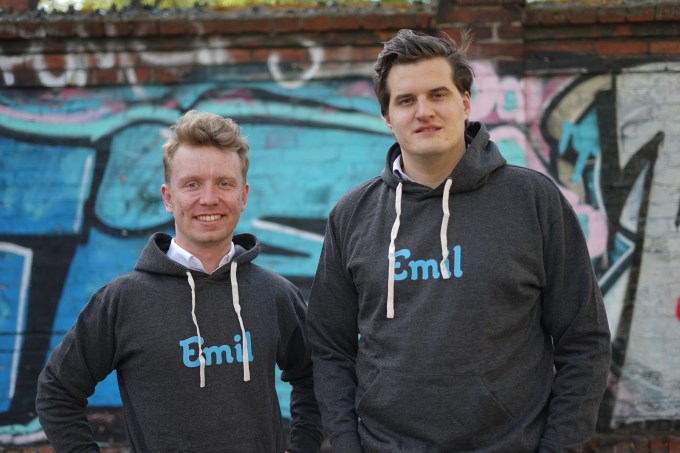
Emil, a new startup from the founders of Movinga, has launched what it claims is Germany’s first pay-per-mile car insurance that measures miles in real-time. Aimed at drivers who do less than 6,200 miles per year on average (or roughly 120 miles per week) — which we’re told accounts for 49 percent of German drivers — mileage is tracked via the Emil app and the supplied dongle that plugs into your car’s diagnostics port.

“With Emil we are building a 21st century mobility insurer,” co-founder Bastian Knutzen tells me. “We believe that insurance products that are offered today can be improved on different dimensions and want to change that by offering flexible and fair products tailored around customer needs. We have started with the German car insurance market where traditionally low mileage drivers have subsidised the higher accident risk of high-mileage drivers which has led to an unfair insurance premium distribution”.

Digging a little more into the technology and model behind Emil, Knutzen explained that the Emil stick is an IoT device with an integrated SIM card that plugs into a vehicle’s OBD-II diagnostics port, from where mileage data is sent to the startup’s servers.

“Customers only pay a low monthly base fee and cents per mile when they actually drive,” he says, meaning that low-mileage drivers can make significant savings on their insurance premiums.

In addition, the Emil mobile app gives your car other ‘smart’ features, such as tracking the vehicle’s location, an overview of all trips (“driver’s logbook”), and remote diagnostics.

The insurance policy itself was developed in cooperation with General Reinsurance AG (a Berkshire Hathaway Company) and the German insurer Gothaer Allgemeine Versicherung.

“In general, we target consumers who want an intuitive, convenient and transparent insurance,” adds Knutzen. “Our customers use their smartphones and other gadgets for payment, banking, shopping, etc., but can’t for insurance. We try to meet that type of expectation for insurance products as well.

More broadly, Emil is tapping into current trends such as growing environmental awareness, urbanisation and car-sharing. “We have decided to offer an insurance which rewards people for not using their cars as our first product. There is a significant price advantage for customers driving less than 6,200 miles annually, which covers around half of German car drivers,” Knutzen says.

Meanwhile, I’m told that Emil’s only funding to date is a “seven-digit” seed round from multiple family offices and business angels with ties to the technology, automotive and insurance industry. They include Johannes Reck (co-founder of GetYourGuide), Lucas von Cranach (co-founder of Onefootball), Roland Grenke (co-founder of Dubsmash), Philip Petrescu (co-founder of Lendico), Verena Pausder (co-founder of Fox & Sheep), Arndt Ellinghorst (German automotive expert), and Oliver Mickler (co-founder Tillhub, co-founder MyDriver and the first angel backer of Movinga).


from TechCrunch https://ift.tt/2ysGfcj

TECH NEWS:~ Fake news ‘threat to democracy’ report gets back-burner response from UK gov’t

The UK government has rejected a parliamentary committee’s call for a levy on social media firms to fund digital literacy lessons to combat the impact of disinformation online.

The recommendation of a levy on social media platforms was made by the Digital, Culture, Media and Sport committee three months ago, in a preliminary report following a multi-month investigation into the impact of so-called ‘fake news’ on democratic processes.

Though it has suggested the terms ‘misinformation’ and ‘disinformation’ be used instead, to better pin down exact types of problematic inauthentic content — and on that at least the government agrees. But just not on very much else. At least not yet.

Among around 50 policy suggestions in the interim report — which the committee put out quickly exactly to call for “urgent action” to ‘defend democracy’ — it urged the government to put forward proposals for an education levy on social media.

But in its response, released by the committee today, the government writes that it is “continuing to build the evidence base on a social media levy to inform our approach in this area”.

“We are aware that companies and charities are undertaking a wide range of work to tackle online harms and would want to ensure we do not negatively impact existing work,” it adds, suggesting it’s most keen not to be accused of making a tricky problem worse.

Earlier this year the government did announce plans to set up a dedicated national security unit to combat state-led disinformation campaigns, with the unit expected to monitor social media platforms to support faster debunking of online fakes — by being able to react more quickly to co-ordinated interference efforts by foreign states.

But going a step further and requiring social media platforms themselves to pay a levy to fund domestic education programs — to arm citizens with critical thinking capabilities so people can more intelligently parse content being algorithmically pushed at them — is not, apparently, forming part of government’s current thinking.

Though it is not taking the idea of some form of future social media tax off the table entirely, as it continues seeking ways to make big tech pay a fairer share of earnings into the public purse, also noting in its response: “We will be considering any levy in the context of existing work being led by HM Treasury in relation to corporate tax and the digital economy.”

As a whole, the government’s response to the DCMS committee’s laundry list of policy recommendations around the democratic risks of online disinformation can be summed up in a word as ‘cautious’ — with only three of the report’s forty-two recommendations being accepted outright, as the committee tells it, and four fully rejected.

Most of the rest are being filed under ‘come back later — we’re still looking into it’.

So if you take the view that ‘fake news’ online has already had a tangible and worrying impact on democratic debate the government’s response will come across as underwhelming and lacking in critical urgency. (Though it’s hardly alone on that front.)

The committee has reacted with disappointment — with chair Damian Collins dubbing the government response “disappointing and a missed opportunity”, and also accusing ministers of hiding behind ‘ongoing investigations’ to avoid commenting on the committee’s call that the UK’s National Crime Agency urgently carry out its own investigation into “allegations involving a number of companies”.

Earlier this month Collins also called for the Met Police to explain why they had not opened an investigation into Brexit-related campaign spending breaches.

It has also this month emerged that the force will not examine claims of Russian meddling in the referendum.

Meanwhile the political circus and business uncertainty triggered by the Brexit vote goes on.

Holding pattern

The bulk of the government’s response to the DCMS interim report entails flagging a number of existing and/or ongoing consultations and reviews — such as the ‘Protecting the Debate: Intimidating, Influence and Information‘ consultation, which it launched this summer.

But by saying it’s continuing to gather evidence on a number of fronts the government is also saying it does not feel it’s necessary to rush through any regulatory responses to technology-accelerated, socially divisive/politically sensitive viral nonsense — claiming also that it hasn’t seen any evidence that malicious misinformation has been able to skew genuine democratic debate on the domestic front.

It’ll be music to Facebook’s ears given the awkward scrutiny the company has faced from lawmakers at home and, indeed, elsewhere in Europe — in the wake of a major data misuse scandal with a deeply political angle.

The government also points multiple times to a forthcoming oversight body which is in the process of being established — aka the Centre for Data Ethics and Innovation — saying it expects this to grapple with a number of the issues of concern raised by the committee, such as ad transparency and targeting; and to work towards agreeing best practices in areas such as “targeting, fairness, transparency and liability around the use of algorithms and data-driven technologies”.

Identifying “potential new regulations” is another stated role for the future body. Though given it’s not yet actively grappling with any of these issues the UK’s democratically concerned citizens are simply being told to wait.

“The government recognises that as technological advancements are made, and the use of data and AI becomes more complex, our existing governance frameworks may need to be strengthened and updated. That is why we are setting up the Centre,” the government writes, still apparently questioning whether legislative updates are needed — this in a response to the committee’s call, informed by its close questioning of tech firms and data experts, for an oversight body to be able to audit “non-financial” aspects of technology companies (including security mechanism and algorithms) to “ensure they are operating responsibly”.

“As set out in the recent consultation on the Centre, we expect it to look closely at issues around the use of algorithms, such as fairness, transparency, and targeting,” the government continues, noting that details of the body’s initial work program will be published in the fall — when it says it will also put out its response to the aforementioned consultation.

It does not specify when the ethics body will be in any kind of position to hit this shifty ground running. So again there’s zero sense the government intends to act at a pace commensurate with the fast-changing technologies in question.

Then, where the committee’s recommendations touch on the work of existing UK oversight bodies, such as Competition and Markets Authority, the ICO data watchdog, the Electoral Commission and the National Crime Agency, the government dodges specific concerns by suggesting it’s not appropriate for it to comment “on independent bodies or ongoing investigations”.

Also notable: It continues to reject entirely the idea that Russian-backed disinformation campaigns have had any impact on domestic democratic processes at all — despite public remarks by prime minister Theresa May  last year generally attacking Putin for weaponizing disinformation for election interference purposes.

Instead it writes:

We want to reiterate, however, that the Government has not seen evidence of successful use of disinformation by foreign actors, including Russia, to influence UK democratic processes. But we are not being complacent and the Government is actively engaging with partners to develop robust policies to tackle this issue.

Its response on this point also makes no reference of the extensive use of social media platforms to run political ads targeting the 2016 Brexit referendum.

Nor does it make any note of the historic lack of transparency of such ad platforms. Which means that it’s simply not possible to determine where all the ad money came from to fund digital campaigning on domestic issues — with Facebook only just launching a public repository of who is paying for political ads and badging them as such in the UK, for example.

The elephant in the room is of course that ‘lack of evidence’ is not necessarily evidence of a lack of success, especially when it’s so hard to extract data from opaque adtech platforms in the first place.

Moreover, just this week fresh concerns have been raised about how platforms like Facebook are still enabling dark ads to target political messages at citizens — without it being transparently clear who is actually behind and paying for such campaigns…

In turn triggering calls from opposition MPs for updates to UK election law…

Yet the government, busily embroiled as it still is with trying to deliver some kind of Brexit outcome, is seemingly unconcerned by all this unregulated, background ongoing political advertising.

It also directly brushes off the committee’s call for it to state how many investigations are currently being carried out into Russian interference in UK politics, saying only that it has taken steps to ensure there is a “coordinated structure across all relevant UK authorities to defend against hostile foreign interference in British politics, whether from Russia or any other State”, before reiterating: “There has, however, been no evidence to date of any successful foreign interference.”

This summer the Electoral Commission found that the official Vote Leave campaign in the UK’s in/out EU referendum had broken campaign spending rules — with social media platforms being repurposed as the unregulated playing field where election law could be diddled at such scale. That much is clear.

The DCMS committee had backed the Commission’s call for digital imprint requirements for electronic campaigns to level the playing field between digital and print ads.

However the government has failed to back even that pretty uncontroversial call, merely pointing again to a public consultation (which ends today) on proposed changes to electoral law. So it’s yet more wait and see.

The committee is also disappointed about the lack of government response to its call for the Commission to establish a code for advertising through social media during election periods; and its recommendation that “Facebook and other platforms take responsibility for the way their platforms are used” — noting also the government made “no response to Facebook’s failure to respond adequately to the Committee’s inquiry and Mark Zuckerberg’s reluctance to appear as a witness“. (A reluctance that really enraged the committee.)

In a statement on the government’s response, committee chair Damian Collins writes: “The government’s response to our interim report on disinformation and ‘fake news’ is disappointing and a missed opportunity. It uses other ongoing investigations to further delay desperately needed announcements on the ongoing issues of harmful and misleading content being spread through social media.

“We need to see a more coordinated approach across government to combat campaigns of disinformation being organised by Russian agencies seeking to disrupt and undermine our democracy. The government’s response gives us no real indication of what action is being taken on this important issue.”

Collins finds one slender crumb of comfort, though, that the government might have some appetite to rule big tech.

After the committee had called for government to “demonstrate how seriously it takes Facebook’s apparent collusion in spreading disinformation in Burma, at the earliest opportunity”, the government writes that it: “has made it clear to Facebook, and other social media companies, that they must do more to remove illegal and harmful content”; and noting also that its forthcoming Online Harms White Paper will include “a range of policies to tackle harmful content”.

“We welcome though the strong words from the Government in its demand for action by Facebook to tackle the hate speech that has contributed to the ethnic cleansing of the Rohingya in Burma,” notes Collins, adding: “We will be looking for the government to make progress on these and other areas in response to our final report which will be published in December.

“We will also be raising these issues with the Secretary of State for DCMS, Jeremy Wright, when he gives evidence to the Committee on Wednesday this week.”

(Wright being the new minister in charge of the UK’s digital brief, after Matt Hancock moved over to health.)

We’ve reached out to Facebook for comment on the government’s call for a more robust approach to illegal hate speech.

Last week the company announced it had hired former UK deputy prime minister, Nick Clegg, to be its new head of global policy and comms — apparently signalling a willingness to pay a bit more attention to European regulators.


from TechCrunch https://ift.tt/2ytoWIe

TECH NEWS:~ Walmart’s marketplace items get free 2-day shipping, in-store returns

With Fulfillment by Amazon, marketplace sellers can make their products eligible for Amazon Prime’s 2-day shipping. Today, Walmart is catching up on this front. The retailer today announced it’s expanding its 2-day shipping to the millions of products offered by its own marketplace sellers. This expansion will roll out in the months ahead, alongside a process for simpler returns on marketplace purchases.

Walmart first launched free, 2-day shipping across millions of products back in January 2017, for orders that were over $35. The move was meant to challenge Amazon Prime, as all it required was a minimum purchase – not an annual membership fee.

Now, that same shipping option will be made available across Walmart’s marketplace, too.

The company says it will initially work with its hundreds of “high-performing” sellers to introduce free, two-day shipping across their eligible items in the U.S. This is being announced today, but will roll out more broadly in the coming months, Walmart notes.

The company tells us it’s implementing 2-day shipping in a number of ways.

It’s enabling it for sellers with their own internal capabilities and it’s introducing the ability to implement geographical settings so two-day shipping is available for specific areas based on the location of an individual seller’s fulfillment network, it says.

Plus, Walmart is working with third-party providers to help fulfill the items, such as Deliverr.

In addition to two-day shipping, Walmart is simplifying returns for items bought through its online marketplace by offering an easier way to manage online returns. Customers will now be able to log into their Walmart.com account and print out a return label to ship items directly back to sellers.

But shipping isn’t always the easiest way to manage returns. That’s where the retailer’s brick-and-mortar stores will come in. Starting in mid-November, customers will be able to return their eligible marketplace purchases in Walmart stores at the Services desk.

Previously, Walmart’s own items could be returned in store, but not those bought from third-party sellers.

Walmart says that 140 million customers shop its stores weekly, and 90% of Americans today live within 10 miles of one of its locations.

With this change, Walmart will facilitate the return of marketplace items by shipping items back to sellers on the customer’s behalf. The customer will then receive a refund from the seller.

This service will be available at all of Walmart’s 4,700 stores, the retailer notes.


from TechCrunch https://ift.tt/2D01aHA

TECH NEWS:~ Oracle acquires DataFox, a developer of ‘predictive intelligence as a service’ across millions of company records

Oracle today announced that it has made another acquisition, this time to enhance both the kind of data that it can provide to its business customers, and its artificial intelligence capabilities: it is buying DataFox, a startup that has amassed a huge company database — currently covering 2.8 million public and private businesses, adding 1.2 million each year — and uses AI to analyse that to make larger business predictions. The business intelligence resulting from that service can in turn be used for a range of CRM-related services: prioritising sales accounts, finding leads, and so on.

“The combination of Oracle and DataFox will enhance Oracle Cloud Applications with an extensive set of AI-derived company-level data and signals, enabling customers to reach even better decisions and business outcomes,” noted Steve Miranda, EVP of applications development at Oracle, in a note to DataFox customers announcing the deal. He said that DataFox will sit among Oracle’s existing portfolio of business planning services like ERP, CX, HCM and SCM. “Together, Oracle and DataFox will enrich cloud applications with AI-driven company-level data, powering recommendations to elevate business performance across the enterprise.”

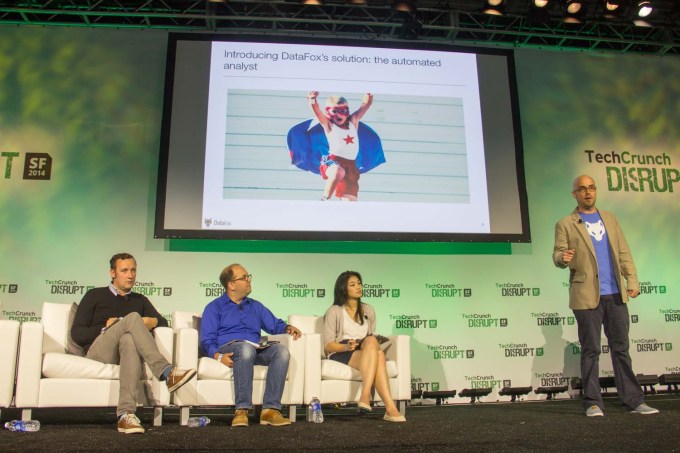
Terms of the deal do not appear to have been disclosed but we are trying to find out. DataFox — which launched in 2014 as a contender in the TC Battlefield at Disrupt — had raised just under $19 million and was last valued at $33 million back in January 2017, according to PitchBook. Investors in the company included Slack, GV, Howard Linzon, and strategic investor Goldman Sachs among others.

Oracle said that it is not committing to a specific product roadmap for DataFox longer term, but for now it will be keeping the product going as is for those who are already customers. The startup counted Goldman Sachs, Bain & Company and Twilio among those using its services. 

The deal is interesting for a couple of reasons. First, it shows that larger platform providers are on the hunt for more AI-driven tools to provide an increasingly sophisticated level of service to customers. Second, in this case, it’s a sign of how content remains a compelling proposition, when it is presented and able to be manipulated for specific ends. Many customer databases can get old and out of date, so the idea of constantly trawling information sources in order to create the most accurate record of businesses possible is a very compelling idea to anyone who has faced the alternative, and that goes even more so in sales environments when people are trying to look their sharpest.

It also shows that, although both companies have evolved quite a lot, and there are many other alternatives on the market, Oracle remains in hot competition with Salesforce for customers and are hoping to woo and keep more of them with the better, integrated innovations. That also points to Oracle potentially cross and up-selling people who come to them by way of DataFox, which is an SaaS that pitches itself very much as something anyone can subscribe to online.


from TechCrunch https://ift.tt/2NXRChi

TECH NEWS:~ Twitter says it has removed several accounts affiliated with Infowars and Alex Jones

Twitter has cleared more Infowars related accounts off its platform. The company told CNN today that it permanently suspended 18 accounts affiliated with the far-right website, known for spreading misinformation and conspiracy theories, on Monday after “numerous violations and warnings.” It added the removals were in addition to five Infowars affiliated accounts that had been already been banned.

Alex Jones and Infowars, which he launched in 1999, had their accounts permanently suspended by Twitter last month, one of the last major social media platforms to do so. Infowars, however, had been using affiliated accounts to get around the ban and promote its content, according to a Daily Beast report last week. These included the accounts of Infowars’ “Real News” show, the Infowars store (which sells Jones’ line of dietary supplements) and “News Wars,” which promoted videos by Infowars. All of these accounts, and several others, were mentioned in the Daily Beast article and included in Twitter’s purge on Monday.

Alex Jones and Infowars are notorious for spreading some of the most pernicious conspiracy theories to emerge recently, including ones claiming the Sandy Hook and Parkland school shootings were faked. Their articles and videos have also frequently included racist and homophobic content and frequent calls for violence.

A wave of social media and tech companies began suspending accounts maintained by Alex Jones and Infowars in August for violating their policies on hate speech and violence. After weeks of prevarication and half-measures, including a brief temporary ban, Twitter permanently removed both @realalexjones and @infowars at the beginning of September. The list of platforms Infowars and Alex Jones are now barred from include Twitter, YouTube, Spotify, and the App Store.

TechCrunch has contacted Twitter and Infowars for comment.


from TechCrunch https://ift.tt/2RbfbWf

TECH NEWS:~ Water Abundance Xprize’s $1.5M winner shows how to source fresh water from the air

You may remember that back in March, the Water Abundance Xprize named the five finalists in its contest to demonstrate the sustainable and scalable collection of water from the air. Interestingly, none of those finalists were the winner — after one dropped out, an eliminated team stepped in and took the prize.

The goal of the program was to  collect “a minimum of 2,000 liters of water per day from the atmosphere using 100 percent renewable energy, at a cost of no more than 2 cents per liter.” No simple task! In fact, I would have guessed it was an impossible one.

But many teams made the attempt anyway, and with a variety of approaches at that. For instance, the runner-up and $150K prize winner, Hawaii’s JMCC Wing, combined a large, super-efficient wind turbine with a commercial condenser unit.

The winner was Skysource/Skywater Alliance, which has already deployed many of its units abroad (and, apparently, at Miranda Kerr’s house). They can run off the grid or alternative power sources, and use an extremely efficient adiabatic distillation method. The one for the contest was a new prototype they call Wood-to-Energy Deployed Emergency Water, or WEDEW.

It’s cheaper and more efficient than desalination, and doesn’t require the presence of nearby water sources or rain. Skywater boxes, which range from somewhat smaller to rather larger than a refrigerator, can produce up to 300 gallons per day; that’s about 1135 liters, so two of them would meet the contest’s requirements if the cost was low enough and it was running on renewables.

That was sufficiently demonstrated to the Xprize inspection teams, it seems, and the team was this weekend awarded the $1.5 million top prize despite not making it into the finals.

“It has been pretty intense but it’s really been exciting for me to see water come out of our system, because this is connected to real lives in the world,” said team member Jay Hasty in an Xprize video.

This doesn’t mean water scarcity is a solved problem — by a long shot — but competitions like this are great ways of promoting new development in a space and also creating awareness of it. Hopefully Skywater systems will be installed where they’re needed, but development will almost certainly continue on those created by the other teams competing for the prize.


from TechCrunch https://ift.tt/2q7qMdk

TECH NEWS:~ Los Angeles investors and entrepreneurs launch PledgeLA, a diversity and inclusion program

In an attempt to boost diversity and inclusion efforts and civic engagement between the growing technology industry in Los Angeles and the community that surrounds it, over 80 venture capitalists and entrepreneurs joined the city’s mayor, Eric Garcetti, and the non-profit Annenberg Foundation to announce PledgeLA.

The initiative is one way in which the Los Angeles technology community is attempting to ensure that it does not repeat the same mistakes made by Silicon Valley and San Francisco and alienate fellow citizens who could feel left out of the opportunities created by tech’s rise to prominence in the city.

“L.A.’s tech growth is no accident – it is a tribute to our region’s tradition of creativity, leadership in innovation, and wealth of talent. With PledgeLA, we will promote transparency in a growing sector and open the doors of opportunity to our diverse base of workers, no matter their race, gender, or background,” said Garcetti, in a statement.

As part of the diversity and inclusion effort, the signatories to PledgeLA have agreed to track civic participation and diversity data each year and to make that data publicly available.

The metrics that signatories will track include community engagement statistics like participation in mentorship programs, volunteering, board service, offering internships, using local banks, giving preference to vendors owned by women or minorities, dedicating a portion of annual spending to local impact initiatives, and investing in local Los Angeles startups.

Demographics at funds and startups will also be under the microscope, since signatories have agreed to report on their composition by race, gender, age, sexual orientation, disability status, immigration status, veteran status, educational attainment, socioeconomic origin, tenure at a firm. PledgeLA participants will also need a code of conduct around diversity and inclusion and are required to privilege diversity in corporate hiring practices.

Over the past five years, Los Angeles has emerged as one of the top five destinations in the U.S. for technology investment and corporate development. It’s one of the fastest growing tech hubs in the country with the 100 largest tech companies in L.A. and Orange County reporting a 24 percent increase in employment from the previous year, according to data provided by the Annenberg Foundation.

The local non-profit was instrumental in setting up the PledgeLA initiative, which grew out of discussions that the institute fostered among the Los Angeles venture community.

Nonetheless, diverse talent remains vastly underrepresented in the workforce of the local tech sector. The landmark
PledgeLA initiative grew out of a series of problem-solving sessions within the Los Angeles venture capital community.

“This commitment from L.A.’s venture capitalists and Mayor Garcetti means that change is happening, and this change is good, as long as we can work to make Los Angeles a more diverse, inclusive and community-focused city that benefits everyone,” said Annenberg Foundation Chairman, President and chief executive Wallis Annenberg, in a statement.

For Los Angeles investors like Upfront Ventures partner, Kobie Fuller, diverse hiring practices are just good business sense.

“Investing in a diverse array of founders, looking for talent in all corners of the city, and bringing different voices to the table when making decisions on investments is just smart business,” Fuller said in a statement. “We know companies with a diverse workforce are more successful, which, in turn, increases community engagement and provides opportunities for the community-at-large. PledgeLA will put Los Angeles on the right trajectory.”

Nearly every large investment firm and Los Angeles based company agreed to sign on to the pledge with at least three notable exceptions. Neither Snap, SpaceX, nor Tesla appear on the list of companies willing to participate in the diversity pledge.


from TechCrunch https://ift.tt/2yu2Bud

TECH NEWS:~ Looks like Tiger Global Management just closed the second biggest venture fund this year

As we noted six months ago, Tiger Global Management, the 17-year-old investment group, is starting to see a whole lot of its venture-related startup investments pay off. We also guessed that because of those wins, the outfit was likely lining up commitments for a new mega fund.

It was a safe bet. According to a new report from the Financial Times, the New York-based outfit has just closed its newest venture vehicle with $3.75 billion after actively marketing it for just six weeks.

That makes Tiger’s new vehicle one of the largest venture funds in a world suddenly clotted with ever-bigger pools of capital, including SoftBank’s massive $93 billion Vision Fund, which closed last year, and the newest global fund assembled by Sequoia, which closed with $8 billion in capital commitments in late summer, a record-breaking amount for the storied venture firm.

In fact, Tiger’s new fund may be the second largest venture fund to close so far this year, just beating out YF Capital’s newest pool, which closed with $2.5 billion in July, and numerous other firms to close billion-dollar-plus funds in 2018, including: Tunlan Investment’s Xiong’An Global Blockchain Innovation Fund, which closed in April with $1.6 billion; Lightspeed Venture Partners, which closed on $1.8 billion in capital across two new funds in July; General Catalyst, which gathered up at least $1.375 billion in capital commitments earlier this year; and GGV Capital, which just last week closed on $1.9 billion across three funds that will back both U.S. and China-based companies.

According to the FT,  the Tiger fund closed exactly a week ago and will focus on both enterprise as well as direct-to-consumer companies in the U.S., China and India, where, according to The Economic Times, Tiger is stepping up its investments after hitting the pause button for a few years. Tiger’s apparent inspiration: the reported $3.3 billion it recently made from an early bet on Flipkart, which sold the majority of its e-commerce business to retail giant Walmart in May for $16 billion.

Other recent developments that Tiger’s investors have surely liked seeing include the sale of Glassdoor, the jobs and salary website, acquired by the Japanese human resources company Recruit Holdings for $1.2 billion in cash back in May; Spotify’s direct listing on the U.S. stock market back in April (the company is currently valued at $26 billion); and even more recent exits, including the IPOs of both Eventbrite and SurveyMonkey — though both have handed back some gains since going public last month. Eventbrite opened at $36 per share and is currently trading at $26 per share; SurveyMonkey has lost roughly one-third of its value since its first trading day.

Tiger was founded by Chase Coleman, a protégé of hedge fund pioneer Julian Robertson. According to the FT, the outfit now manages roughly $26 billion and about half of that is being funneled into venture-backed startups, with portfolio manager Lee Fixel largely overseeing its venture bets.

Some of its investments have been contrarian and underscore the extent to which Tiger is not like other investment firms. It took a stake of more than $1 billion in SoftBank Group earlier this year, for example, reportedly on the belief that it was undervalued at the time. Tiger is also an investor in the e-cig company Juul, which has come under intense regulatory scrutiny in recent months but remains among the fastest-growing companies in the Bay Area right now.

Interestingly, even SoftBank’s Vision Fund — which is currently in an uncomfortable public position, having raised nearly half its money from Saudi Arabia’s Crown Prince Mohammed bin Salman — couldn’t invest in Juul if it wanted to. According to Jeff Housenbold, a managing director with SoftBank’s Vision Fund, like many other venture investors, SoftBank has prohibitive clauses in its agreement with its own backers that include pornography, alcohol, drugs, weapons and tobacco.

Whether Tiger has also raised money from sovereign wealth funds, we don’t know. The firm has never publicly disclosed who, beyond its employees, owns shares in the firm.


from TechCrunch https://ift.tt/2CZuC0w

TECH NEWS:~ Guillermo del Toro is making a stop-motion Pinocchio movie for Netflix

Guillermo del Toro, the Academy Award-winning director of “The Shape of Water” (not to mention “Hellboy,” “Pan’s Labyrinth” and “Pacific Rim”) is making a new version of “Pinocchio” for Netflix.

I’d thought that after del Toro’s awards victory earlier this year he might finally make his long-thwarted adaptation “At the Mountains of Madness.” And while I’m not giving up hope that I’ll see a del Toro-helmed version of the classic H.P. Lovecraft horror story one day, it seems that he’s going in a different direction for now.

The official announcement from Netflix describes this as del Toro’s “lifelong passion project,” and says that it will be both a stop-motion animated film and a musical.

“No art form has influenced my life and my work more than animation and no single character in history has had as deep of a personal connection to me as Pinocchio,” del Toro said in a statement. “In our story, Pinocchio is an innocent soul with an uncaring father who gets lost in a world he cannot comprehend. He embarks on an extraordinary journey that leaves him with a deep understanding of his father and the real world. I’ve wanted to make this movie for as long as I can remember.”

This isn’t the director’s first project for Netflix — he previously created the animated series “Trollhunters,” and he has another series in the works for the streaming service, “Guillermo del Toro Presents 10 After Midnight.” Netflix says that in addition to directing the film with Mark Gustafson (“The Fantastic Mr. Fox”), he will co-write and co-produce it. The Jim Henson Company (which is also making a “Dark Crystal” prequel series for Netflix) and ShadowMachine are producing as well.

Netflix also announced today that it’s raising an additional $2 billion in debt to fund its original content plans. It says production on “Pinocchio” will begin this fall.


from TechCrunch https://ift.tt/2POgha4

TECH NEWS:~ Uber’s head of corporate development resigns

Less than one month after The Wall Street Journal reported allegations of sexual misconduct by Cameron Poetzscher, Uber’s head of corporate development, Poetzscher has resigned, according to the WSJ.

Uber has confirmed Poetzscher’s resignation to TechCrunch. While Uber searches for a new corporate development lead, Uber CFO Nelson Chai will oversee Poetzscher’s duties.

“We thank Cam for his four and a half years of service to Uber,” an Uber spokesperson told TechCrunch.

Uber had previously hired an outside firm to look into allegations against Poetzscher. That firm reportedly found Poetzscher did indeed have a history of making sexual remarks about female Uber employees. Uber reportedly proceeded to give him a formal warning, reduced his annual bonus and required that Poetzscher take sensitivity training.

However, Uber later promoted him to acting head of finance. At the time of the WSJ’s article last month, Poetzscher said he was “rightfully disciplined” and that he had “learned from this error in judgment.”


from TechCrunch https://ift.tt/2q4lmQ7

TECH NEWS:~ The future of photography is code

What’s in a camera? A lens, a shutter, a light-sensitive surface and, increasingly, a set of highly sophisticated algorithms. While the physical components are still improving bit by bit, Google, Samsung and Apple are increasingly investing in (and showcasing) improvements wrought entirely from code. Computational photography is the only real battleground now.

The reason for this shift is pretty simple: Cameras can’t get too much better than they are right now, or at least not without some rather extreme shifts in how they work. Here’s how smartphone makers hit the wall on photography, and how they were forced to jump over it.

Not enough buckets

An image sensor one might find in a digital camera

The sensors in our smartphone cameras are truly amazing things. The work that’s been done by the likes of Sony, OmniVision, Samsung and others to design and fabricate tiny yet sensitive and versatile chips is really pretty mind-blowing. For a photographer who’s watched the evolution of digital photography from the early days, the level of quality these microscopic sensors deliver is nothing short of astonishing.

But there’s no Moore’s Law for those sensors. Or rather, just as Moore’s Law is now running into quantum limits at sub-10-nanometer levels, camera sensors hit physical limits much earlier. Think about light hitting the sensor as rain falling on a bunch of buckets; you can place bigger buckets, but there are fewer of them; you can put smaller ones, but they can’t catch as much each; you can make them square or stagger them or do all kinds of other tricks, but ultimately there are only so many raindrops and no amount of bucket-rearranging can change that.

Sensors are getting better, yes, but not only is this pace too slow to keep consumers buying new phones year after year (imagine trying to sell a camera that’s 3 percent better), but phone manufacturers often use the same or similar camera stacks, so the improvements (like the recent switch to backside illumination) are shared amongst them. So no one is getting ahead on sensors alone.

Perhaps they could improve the lens? Not really. Lenses have arrived at a level of sophistication and perfection that is hard to improve on, especially at small scale. To say space is limited inside a smartphone’s camera stack is a major understatement — there’s hardly a square micron to spare. You might be able to improve them slightly as far as how much light passes through and how little distortion there is, but these are old problems that have been mostly optimized.

The only way to gather more light would be to increase the size of the lens, either by having it A: project outwards from the body; B: displace critical components within the body; or C: increase the thickness of the phone. Which of those options does Apple seem likely to find acceptable?

In retrospect it was inevitable that Apple (and Samsung, and Huawei, and others) would have to choose D: none of the above. If you can’t get more light, you just have to do more with the light you’ve got.

Isn’t all photography computational?

The broadest definition of computational photography includes just about any digital imaging at all. Unlike film, even the most basic digital camera requires computation to turn the light hitting the sensor into a usable image. And camera makers differ widely in the way they do this, producing different JPEG processing methods, RAW formats and color science.

For a long time there wasn’t much of interest on top of this basic layer, partly from a lack of processing power. Sure, there have been filters, and quick in-camera tweaks to improve contrast and color. But ultimately these just amount to automated dial-twiddling.

The first real computational photography features were arguably object identification and tracking for the purposes of autofocus. Face and eye tracking made it easier to capture people in complex lighting or poses, and object tracking made sports and action photography easier as the system adjusted its AF point to a target moving across the frame.

These were early examples of deriving metadata from the image and using it proactively, to improve that image or feeding forward to the next.

In DSLRs, autofocus accuracy and flexibility are marquee features, so this early use case made sense; but outside a few gimmicks, these “serious” cameras generally deployed computation in a fairly vanilla way. Faster image sensors meant faster sensor offloading and burst speeds, some extra cycles dedicated to color and detail preservation and so on. DSLRs weren’t being used for live video or augmented reality. And until fairly recently, the same was true of smartphone cameras, which were more like point and shoots than the all-purpose media tools we know them as today.

The limits of traditional imaging

Despite experimentation here and there and the occasional outlier, smartphone cameras are pretty much the same. They have to fit within a few millimeters of depth, which limits their optics to a few configurations. The size of the sensor is likewise limited — a DSLR might use an APS-C sensor 23 by 15 millimeters across, making an area of 345 mm2; the sensor in the iPhone XS, probably the largest and most advanced on the market right now, is 7 by 5.8 mm or so, for a total of 40.6 mm2.

Roughly speaking, it’s collecting an order of magnitude less light than a “normal” camera, but is expected to reconstruct a scene with roughly the same fidelity, colors and such — around the same number of megapixels, too. On its face this is sort of an impossible problem.

Improvements in the traditional sense help out — optical and electronic stabilization, for instance, make it possible to expose for longer without blurring, collecting more light. But these devices are still being asked to spin straw into gold.

Luckily, as I mentioned, everyone is pretty much in the same boat. Because of the fundamental limitations in play, there’s no way Apple or Samsung can reinvent the camera or come up with some crazy lens structure that puts them leagues ahead of the competition. They’ve all been given the same basic foundation.

All competition therefore comprises what these companies build on top of that foundation.

Image as stream

The key insight in computational photography is that an image coming from a digital camera’s sensor isn’t a snapshot, the way it is generally thought of. In traditional cameras the shutter opens and closes, exposing the light-sensitive medium for a fraction of a second. That’s not what digital cameras do, or at least not what they can do.

A camera’s sensor is constantly bombarded with light; rain is constantly falling on the field of buckets, to return to our metaphor, but when you’re not taking a picture, these buckets are bottomless and no one is checking their contents. But the rain is falling nevertheless.

To capture an image the camera system picks a point at which to start counting the raindrops, measuring the light that hits the sensor. Then it picks a point to stop. For the purposes of traditional photography, this enables nearly arbitrarily short shutter speeds, which isn’t much use to tiny sensors.

Why not just always be recording? Theoretically you could, but it would drain the battery and produce a lot of heat. Fortunately, in the last few years image processing chips have gotten efficient enough that they can, when the camera app is open, keep a certain duration of that stream — limited resolution captures of the last 60 frames, for instance. Sure, it costs a little battery, but it’s worth it.

Access to the stream allows the camera to do all kinds of things. It adds context.

Context can mean a lot of things. It can be photographic elements like the lighting and distance to subject. But it can also be motion, objects, intention.

A simple example of context is what is commonly referred to as HDR, or high dynamic range imagery. This technique uses multiple images taken in a row with different exposures to more accurately capture areas of the image that might have been underexposed or overexposed in a single exposure. The context in this case is understanding which areas those are and how to intelligently combine the images together.

This can be accomplished with exposure bracketing, a very old photographic technique, but it can be accomplished instantly and without warning if the image stream is being manipulated to produce multiple exposure ranges all the time. That’s exactly what Google and Apple now do.

Something more complex is of course the “portrait mode” and artificial background blur or bokeh that is becoming more and more common. Context here is not simply the distance of a face, but an understanding of what parts of the image constitute a particular physical object, and the exact contours of that object. This can be derived from motion in the stream, from stereo separation in multiple cameras, and from machine learning models that have been trained to identify and delineate human shapes.

These techniques are only possible, first, because the requisite imagery has been captured from the stream in the first place (an advance in image sensor and RAM speed), and second, because companies developed highly efficient algorithms to perform these calculations, trained on enormous data sets and immense amounts of computation time.

What’s important about these techniques, however, is not simply that they can be done, but that one company may do them better than the other. And this quality is entirely a function of the software engineering work and artistic oversight that goes into them.

DxOMark did a comparison of some early artificial bokeh systems; the results, however, were somewhat unsatisfying. It was less a question of which looked better, and more of whether they failed or succeeded in applying the effect. Computational photography is in such early days that it is enough for the feature to simply work to impress people. Like a dog walking on its hind legs, we are amazed that it occurs at all.

But Apple has pulled ahead with what some would say is an almost absurdly over-engineered solution to the bokeh problem. It didn’t just learn how to replicate the effect — it used the computing power it has at its disposal to create virtual physical models of the optical phenomenon that produces it. It’s like the difference between animating a bouncing ball and simulating realistic gravity and elastic material physics.

Why go to such lengths? Because Apple knows what is becoming clear to others: that it is absurd to worry about the limits of computational capability at all. There are limits to how well an optical phenomenon can be replicated if you are taking shortcuts like Gaussian blurring. There are no limits to how well it can be replicated if you simulate it at the level of the photon.

Similarly the idea of combining five, 10, or 100 images into a single HDR image seems absurd, but the truth is that in photography, more information is almost always better. If the cost of these computational acrobatics is negligible and the results measurable, why shouldn’t our devices be performing these calculations? In a few years they too will seem ordinary.

If the result is a better product, the computational power and engineering ability has been deployed with success; just as Leica or Canon might spend millions to eke fractional performance improvements out of a stable optical system like a $2,000 zoom lens, Apple and others are spending money where they can create value: not in glass, but in silicon.

Double vision

One trend that may appear to conflict with the computational photography narrative I’ve described is the advent of systems comprising multiple cameras.

This technique doesn’t add more light to the sensor — that would be prohibitively complex and expensive optically, and probably wouldn’t work anyway. But if you can free up a little space lengthwise (rather than depthwise, which we found impractical) you can put a whole separate camera right by the first that captures photos extremely similar to those taken by the first.

A mock-up of what a line of color iPhones could look like

Now, if all you want to do is re-enact Wayne’s World at an imperceptible scale (camera one, camera two… camera one, camera two…) that’s all you need. But no one actually wants to take two images simultaneously, a fraction of an inch apart.

These two cameras operate either independently (as wide-angle and zoom) or one is used to augment the other, forming a single system with multiple inputs.

The thing is that taking the data from one camera and using it to enhance the data from another is — you guessed it — extremely computationally intensive. It’s like the HDR problem of multiple exposures, except far more complex as the images aren’t taken with the same lens and sensor. It can be optimized, but that doesn’t make it easy.

So although adding a second camera is indeed a way to improve the imaging system by physical means, the possibility only exists because of the state of computational photography. And it is the quality of that computational imagery that results in a better photograph — or doesn’t. The Light camera with its 16 sensors and lenses is an example of an ambitious effort that simply didn’t produce better images, though it was using established computational photography techniques to harvest and winnow an even larger collection of images.

Light and code

The future of photography is computational, not optical. This is a massive shift in paradigm and one that every company that makes or uses cameras is currently grappling with. There will be repercussions in traditional cameras like SLRs (rapidly giving way to mirrorless systems), in phones, in embedded devices and everywhere that light is captured and turned into images.

Sometimes this means that the cameras we hear about will be much the same as last year’s, as far as megapixel counts, ISO ranges, f-numbers and so on. That’s okay. With some exceptions these have gotten as good as we can reasonably expect them to be: Glass isn’t getting any clearer, and our vision isn’t getting any more acute. The way light moves through our devices and eyeballs isn’t likely to change much.

What those devices do with that light, however, is changing at an incredible rate. This will produce features that sound ridiculous, or pseudoscience babble on stage, or drained batteries. That’s okay, too. Just as we have experimented with other parts of the camera for the last century and brought them to varying levels of perfection, we have moved onto a new, non-physical “part” which nonetheless has a very important effect on the quality and even possibility of the images we take.


from TechCrunch https://ift.tt/2yWgcK7
TECH NEWS:~ Richard Branson steps down as chairman of Virgin Hyperloop One

Richard Branson has reportedly stepped down from the chairman role of Virgin Hyperloop One.

In a statement, cited by Reuters, Branson said the company would require more time than he could devote to the company:

At this stage in the company’s evolution, I feel it needs a more hands-on Chair, who can focus on the business and these opportunities. It will be difficult for me to fulfill that commitment as I already devote significant time to my philanthropic ventures and the many business within the Virgin Group.

What wasn’t mentioned was the cancellation of a planned project with Saudi Arabia after Branson criticized the kingdom and suspended negotiations around an intended $1 billion investment from the nation’s Public Investment Fund into Virgin’s space operations.

Branson is one of several business leaders who have cut ties with the Kingdom of Saudi Arabia following the alleged assassination and dismemberment of dissident journalist Jamal Khashoggi.

Virgin Hyperloop’s largest investor is the United Arab Emirates shipping and logistics company DP World. Earlier this year, the two companies launched a logistics joint venture that would bring hyperloop technologies to the industry. DP World first invested in what is now Virgin Hyperloop back in 2016.

Earlier this month, Virgin Hyperloop released the results of a feasibility study conducted with Black & Veatch of the company’s planned route through Missouri to link St. Louis and Kansas City.

The independent report, authored by global infrastructure solutions company Black & Veatch, analyzes a proposed route through the I-70 corridor, the major highway traversing Missouri, and verifies the favorable safety and sustainability opportunities this new mode of transportation offers.

“A feasibility study of this depth represents the first phase of actualization of a full-scale commercial hyperloop system, both for passengers and cargo in the United States,” said chief executive Rob Lloyd, at the time. “We are especially proud that Missouri, with its iconic status in the history of U.S. transportation as the birthplace of the highway system, could be the keystone of a nation-wide network. The resulting socio-economic benefits will have enormous regional and national impact.”

In the U.S., Colorado and Ohio are also examining feasibility studies for Virgin Hyperloop technologies, while other projects are underway in India and the United Arab Emirates.

Hyperloop technology developers like Virgin Hyperloop One and Hyperloop Transportation Technologies got their inspiration from early plans drawn up by Elon Musk.

As we wrote at the time:

The Hyperloop features tubes with a low level of pressurization that would contain pods with skis made of the SpaceX alloy inconel, which is designed to withstand high pressure and heat. Air exiting those skis through tiny holes would create an air cushion on which the pods would ride, and they’d be propelled by air jet inlets. And all of that would cost only around $6 billion, according to Musk.

We’ve reached out to a spokesperson from Virgin Hyperloop One for comment and will update when we hear back.


from TechCrunch https://ift.tt/2EBfc4h

TECH NEWS:~ Ford expands self-driving vehicle program to Washington, D.C.

Ford is bringing its autonomous vehicles to Washington, D.C., the fourth city to join the automaker’s testing program as it prepares to launch a self-driving taxi and delivery service in 2021.

Ford will begin testing its self-driving vehicles in the district in the first quarter of 2019. The company is already is testing in Detroit, Pittsburgh and Miami. 

Ford is a bit different from other companies that have launched autonomous vehicle pilots in the U.S. Ford is pursuing two parallels tracks — testing the business model and autonomous technology — that will eventually combine ahead of its commercial launch in 2021.

Argo AI, the Pittsburgh-based company into which Ford invested $1 billion in 2017, is developing the virtual driver system and high-definition maps designed for Ford’s self-driving vehicles. Meanwhile, Ford is testing its go-to-market strategy through pilot programs with partners like Domino’s and Postmates, and even some local businesses.

The testing program in DC will follow that same thinking, with an emphasis on job creation and equitable deployment. Ford says its autonomous vehicles will be in all eight of the district’s wards. Eventually, it will operate business pilot programs in all eight wards, as well . Ford has already established an autonomous vehicle operations terminal in Ward 5, where it will house, manage and conduct routine maintenance on the fleet and continue developing its vehicle management process.

Argo AI already has vehicles on DC’s streets, mapping roads in the first step toward testing in autonomous mode, the company said.

“Both Ford and district officials are committed to exploring how self-driving vehicles can be deployed in an equitable way across the various neighborhoods that make up Washington, D.C., and in a way that promotes job creation,” Sherif Marakby, CEO, Ford Autonomous Vehicles LLC wrote in a Medium post Monday.

Marakby underscored a recent report by Securing America’s Future Energy that found autonomous technology could improve people’s access to jobs as well as retail markets.

Ford announced in July 2018 plans to spend $4 billion through 2023 in a newly created LLC dedicated to building out an autonomous vehicles business. The new entity, Ford Autonomous Vehicles LLC, houses the company’s self-driving systems integration, autonomous-vehicle research and advanced engineering, AV transportation-as-a-service network development, user experience, business strategy and business development teams. The spending plan includes a $1 billion investment in startup Argo AI.


from TechCrunch https://ift.tt/2CZr5iT

TECH NEWS:~ A look at the Android Market (aka Google Play) on its 10th Anniversary

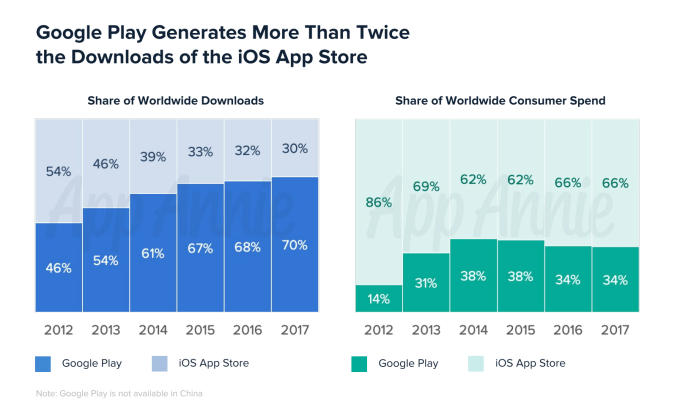
Google Play has generated more than twice the downloads of the iOS App Store, reaching a 70 percent share of worldwide downloads in 2017, according to a new report from App Annie, released in conjunction with the 10th anniversary of the Android Market, now called Google Play. The report also examined the state of Google Play’s marketplace and the habits of Android users.

It found that, despite the large share of downloads, Google Play only accounted for 34 percent of worldwide consumer spend on apps, compared with 66 percent on the iOS App Store in 2017 — a figure that’s stayed relatively consistent for years.

Those numbers are consistent with the narrative that’s been told about the two app marketplaces for some time, as well. That is, Google has the sheer download numbers, thanks to the wide distribution of its devices — including its reach into emerging markets, thanks to low-cost smartphones. But Apple’s ecosystem is the one making more money from apps.

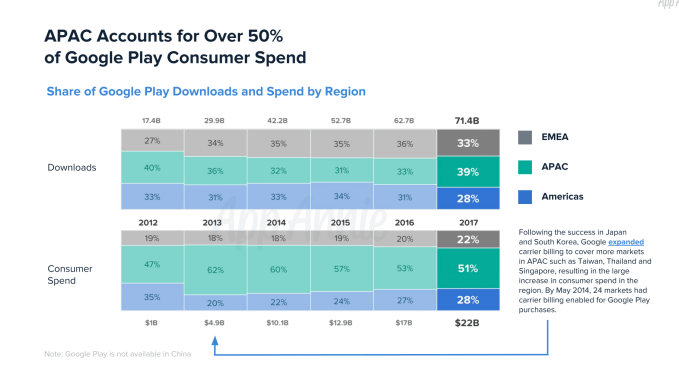
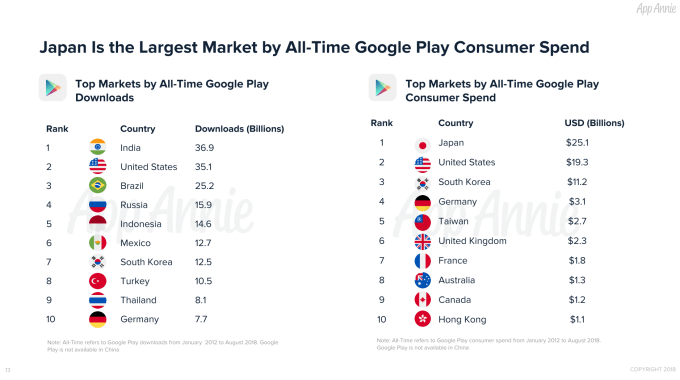
App Annie also found that the APAC (Asia-Pacific) region accounts for more than half of Google Play consumer spending. Japan was the largest market of all-time on this front, topping the charts with $25.1 billion dollars spent on apps and in-app purchases. It was followed by the U.S. ($19.3 billion) and South Korea ($11.2 billion).

The firm attributed some of Google Play’s success in Japan to carrier billing. This has allowed consumer spending to increase in markets like South Korea, Taiwan, Thailand and Singapore, as well, it said.

As to what consumers are spending their money on? Games, of course.

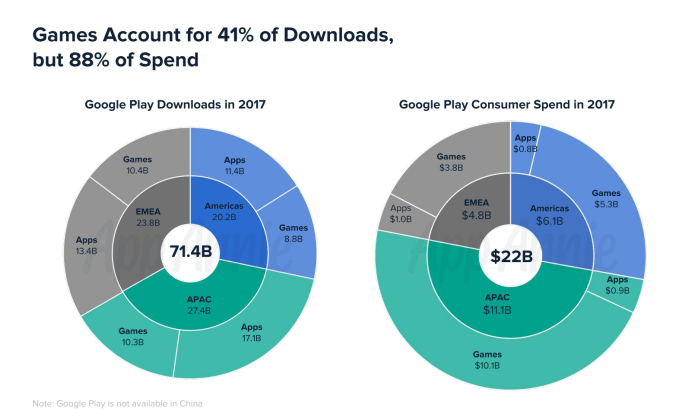
The report found that games accounted for 41 percent of downloads, but 88 percent of spend.

Outside of games, in-app subscriptions have contributed to revenue growth.

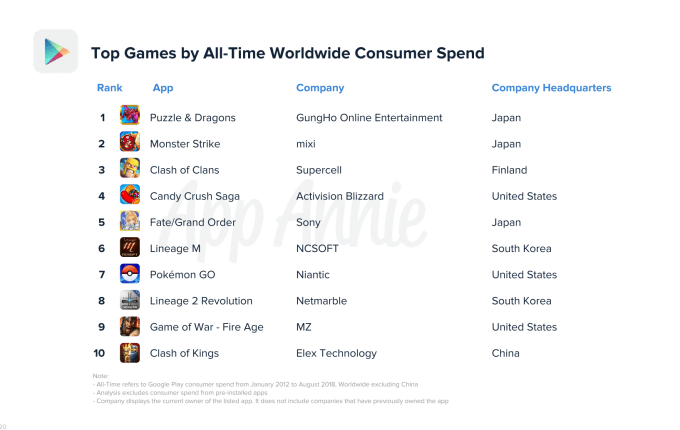
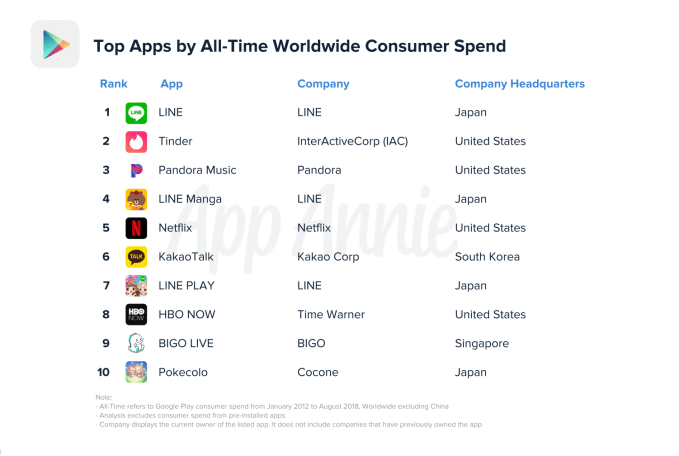
Non-game apps reached $2.7 billion in consumer spend last year, with 4 out of the top 5 apps offering a subscription model. The No. 1 app, LINE, was the exception. It was followed by subscription apps Tinder, Pandora, Netflix and HBO NOW.

In addition, App Annie examined the app usage patterns of Android users, and found they tend to have a lot of apps installed. In several markets, including the U.S. and Japan, Android users had more than 60 apps installed on their phones, and they used more than 30 apps every month.

Australia, the U.S. and South Korea led the way here, with users’ phones holding 100 or more apps.

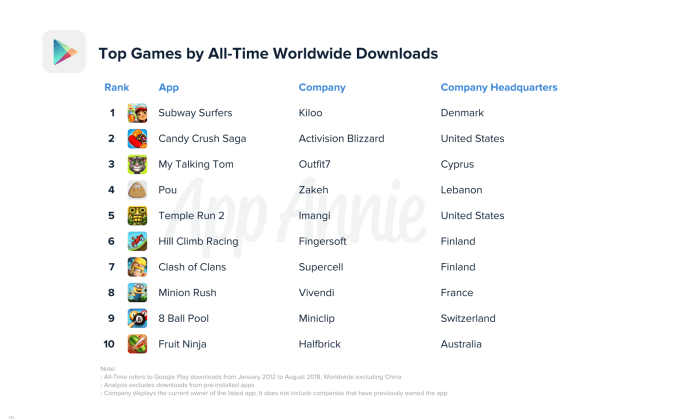
The report also looked at the most popular games and apps of all time by both downloads and consumer spend. There weren’t many surprises on these lists, with apps like those made by Facebook dominating the top apps by downloads list, and subscription services dominating top apps by spend.

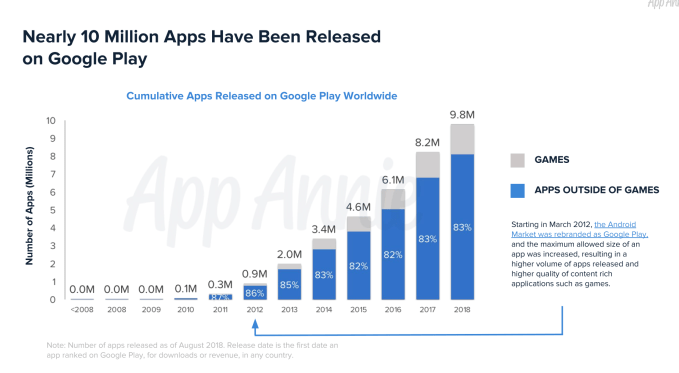
App Annie also noted Google Play has seen the release of nearly 10 million apps since its launch in 2008. Not all these remain, of course — by today’s count, there are just over 2.8 million apps live on Google Play.


The full report is available here.


from TechCrunch https://ift.tt/2R7Sh1Q

TECH NEWS:~ Cowboy, the Belgian e-bike startup, raises €10M Series A

Cowboy, the Belgian startup that designed and sells a smarter electronic bicycle, has raised €10 million in Series A funding.

Leading the round is Tiger Global Management, with participation from previous backers Index Ventures and Hardware Club. The new capital will be used to scale operations and expand beyond Belgium into Germany, U.K., Netherlands and France.

Founded in January 2017 by Adrien Roose and Karim Slaoui, who both previously co-founded Take Eat Easy (an early Deliveroo competitor), and Tanguy Goretti, who previously co-founded ridesharing startup Djump, Cowboy set out to build and sell direct a better designed e-bike.

This included making the Cowboy bike lighter in weight and more stylish than models from incumbents, and adding automatic motor assistance. The latter utilizes built-in sensor technology that measures speed and torque, and adjusts to pedaling style and force to deliver an added boost of motor-assisted speed at key moments, e.g. when you start pedaling, accelerate or go uphill.

In addition, Cowboy’s “smart” features powered by the Cowboy app enables the device to be switched on and off, track location, provide “ride stats” and support remote troubleshooting and software updates. A theft detection feature is also promised soon.

“We designed the Cowboy bike to appeal specifically to people who are yet to be convinced that electric bikes are a practical and mainstream mode of transport,” says Adrien Roose, Cowboy’s CEO, in a statement.

“We focused our attention on the three main reasons people are reluctant to purchase electric bikes: high cost, poor design and redundant technology — or a combination of the above — and we set about fixing them all.”


from TechCrunch https://ift.tt/2JbUl62